Thursday, May 28, 2009

Homebrewed CPU Is a Beautiful Mess of Wires


Intel’s fabrication plants can churn out hundreds of thousands of
processor chips a day. But what does it take to handcraft a single
8-bit CPU and a computer? Give or take 18 months, about $1,000 and
1,253 pieces of wire.


Steve Chamberlin, a Belmont, California, videogame developer by day,
set out on a quest to custom design and build his own 8-bit computer.
The homebrew CPU would be called Big Mess of Wires or BMOW. Despite its
name, it is a painstakingly created work of art.


“Computers can seem like complete black boxes. We understand what
they do, but not how they do it, really,” says Chamberlin. “When I was
finally able to mentally connect the dots all the way from the physics
of a transistor up to a functioning computer, it was an incredible
thrill.”


The 8-bit CPU and computer will be on display doing an interactive chess demo at the fourth annual Maker Faire
in San Mateo, California, this weekend, May 30-31. It will be one of
600 exhibits of do-it-yourself technology, hacks, mods and just plain
strange hobby projects at the faire, which is expected to draw 80,000
attendees.


The BMOW is closest in design to the MOS Technology 6502 processor used in the Apple II, Commodore 64 and early Atari videogame consoles. Chamberlin designed his CPU
to have three 8-bit data registers, a 24-bit address size and 12
addressing modes. It took him about a year and a half from design to
finish. Almost all the components come from the 1970s- and 1980s-era
technology.


“Old ’80s vintage parts may not be very powerful, but they’re easy
to work with and simple to understand,” he says. “They’re like the
Volkswagen Beetles of computer hardware. Nobody argues they’re the best
but we love them for their simplicity.”


To connect the parts, Chamberlin used wire wrapping instead of
soldering. The technique involves taking a hollow, screwdriver-shaped
tool and looping the wire through it to create a tight, secure
connection. Wire wraps
are seen as less prone to failures than soldered junctions but can take
much longer to accomplish. Still, they offer one big advantage, says
Chamberlin.


“Wire wrapping is changeable,” he says. “I can unwrap and start over
if I make a mistake. It is is much harder to recover from a mistake if
you solder.”


Chamberlin started with a a 12×7-inch Augat wire-wrap board with
2,832 gold wire-wrap posts that he purchased from eBay for $50.
Eventually he used 1,253 pieces of wire to create 2,506
individually-wrapped connections, wrapping at the rate of almost 25
wires in an hour. “It’s like a form of meditation,” he wrote on his
blog. “Despite how long it takes to wrap, the wire-wrapping hasn’t
really impacted my overall rate of progress. Design, debugging, and
general procrastination consume the most time.”


The BMOW isn’t just a CPU. Chamberlin added a keyboard input, an LCD
output that shows a strip of text, a USB connection, three-voice audio,
and VGA video output to turn it into a functioning computer. The video
circuitry, a UMC 70C171 color palette chip, was hard to come by, he
says. When Chamberlin couldn’t find a source for it online, he went to
a local electronics surplus warehouse and dug through a box of
20-year-old video cards. Two cards in there had the chip he needed, so
he took one and repurposed it for his project.


The use of retro technology and parts is essential for a home
hobbyist, says Chamberlin. Working with newer electronics technology
can be difficult because a lot of modern parts are surface-mount chips
instead of having through-hole pins. That requires a wave soldering
oven, putting them out of reach of non-professionals.


After months of the CPU sitting naked on his desk, Chamberlin fashioned a case using a gutted X Terminal, a workstation popular in the early 1990s.


“Why did I do all this?” he says. “I don’t know. But it has been a lot of fun.”


Check out Steve Chamberlin’s log of how BMOW was built.


Photo:  Wire wrapped 8-bit CPU/Steve Chamberlin


Credits: Wired.Com


Tuesday, April 28, 2009

Mozilla releases Firefox 3.5 beta

Mozilla on Monday released beta 3.5 of Firefox, a revamp of the open-source Web browser designed to include better performance, several new Web programming features, and a private browsing mode.

The earlier betas had been numbered 3.1, but Mozilla switched to the version 3.5 name after concluding the changes were more significant than it envisioned earlier. Mozilla has said earlier the fourth beta will the last, with more polished release candidates expected before the final version of Firefox 3.5 is released.

The software emerges amid what's become a fiercely competitive browser market. Microsoft has released a significant new version, Internet Explorer 8, while Google has entered the market with Chrome and Apple is trying to secure a Windows foothold for its Safari browser. Firefox holds second place in market share to IE.

Among the changes compared with the current Firefox 3.0.x versions are the faster TraceMonkey engine for running Web sites' JavaScript programs; built-in JSON (JavaScript Object Notation) technology for exchanging data between servers and browsers; support for tags to describe audio and video content the way images have been available for years; the private browsing mode for leaving no traces on your computer while surfing; support for technology to let permitted applications know the user's location; and support for the Web workers standard for letting a browser perform processing in the background without holding back a Web application's user interface.

There are a number of known problems with Gmail and with AVG SafeSearch v8.0 on Windows, and as usual, many of those extensions that are so popular on Firefox could break. For details, check the release notes.


Thursday, April 9, 2009

Conficker Hype Used by Rogue Gangs

As you're all aware Conficker has been in the news a lot lately, especially with regards to if anything will happen on April 1st or not. We found out that rogue security software folks have picked up on this. For example, let's have a look at remove-conficker.org, a domain which was registered today:


They advertise a tool called MalwareRemovalBot. It's fake. Interestingly, it doesn't always find non-existing malware infections on your PC — only sometimes. But one thing is for sure, it does not remove Conficker.C. We tried it and it didn't do a thing to remove it.

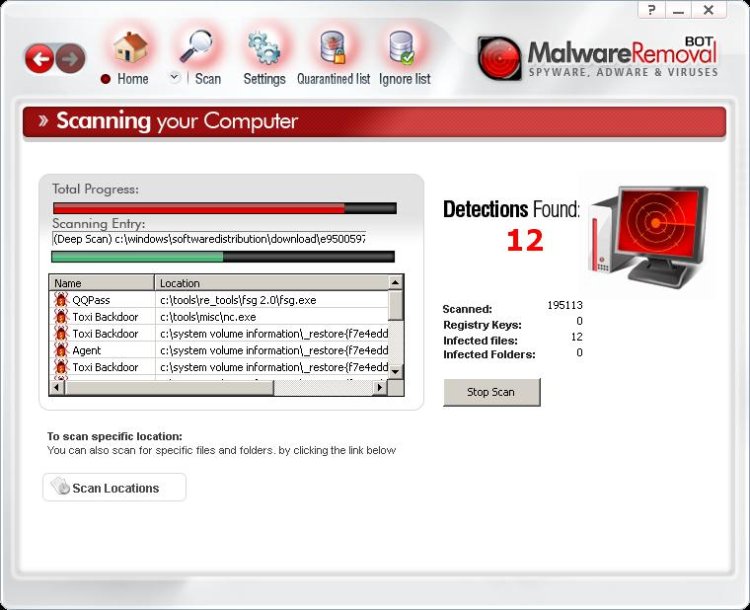
When it did find something that it claimed to be malware it looked like this:


And then it asked us to register and pay $39.95 for the removal functionality.


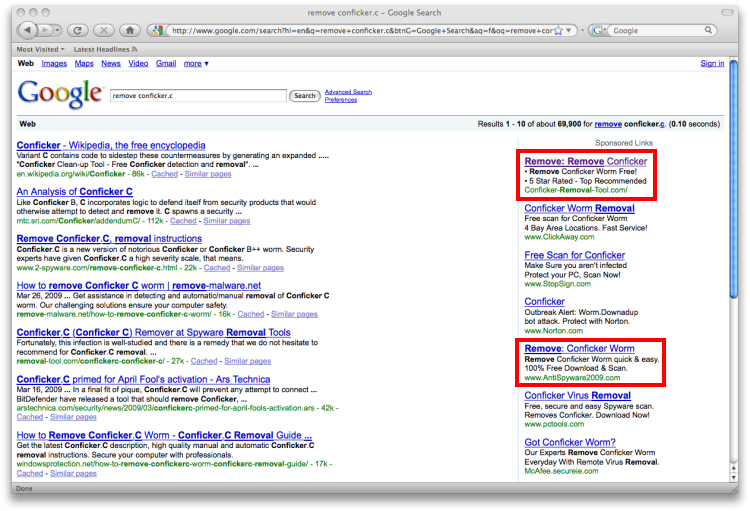
When following up on this we did a Google search for "remove conficker.c" and saw several purchased ads that lead to the same type of "security" software as well.


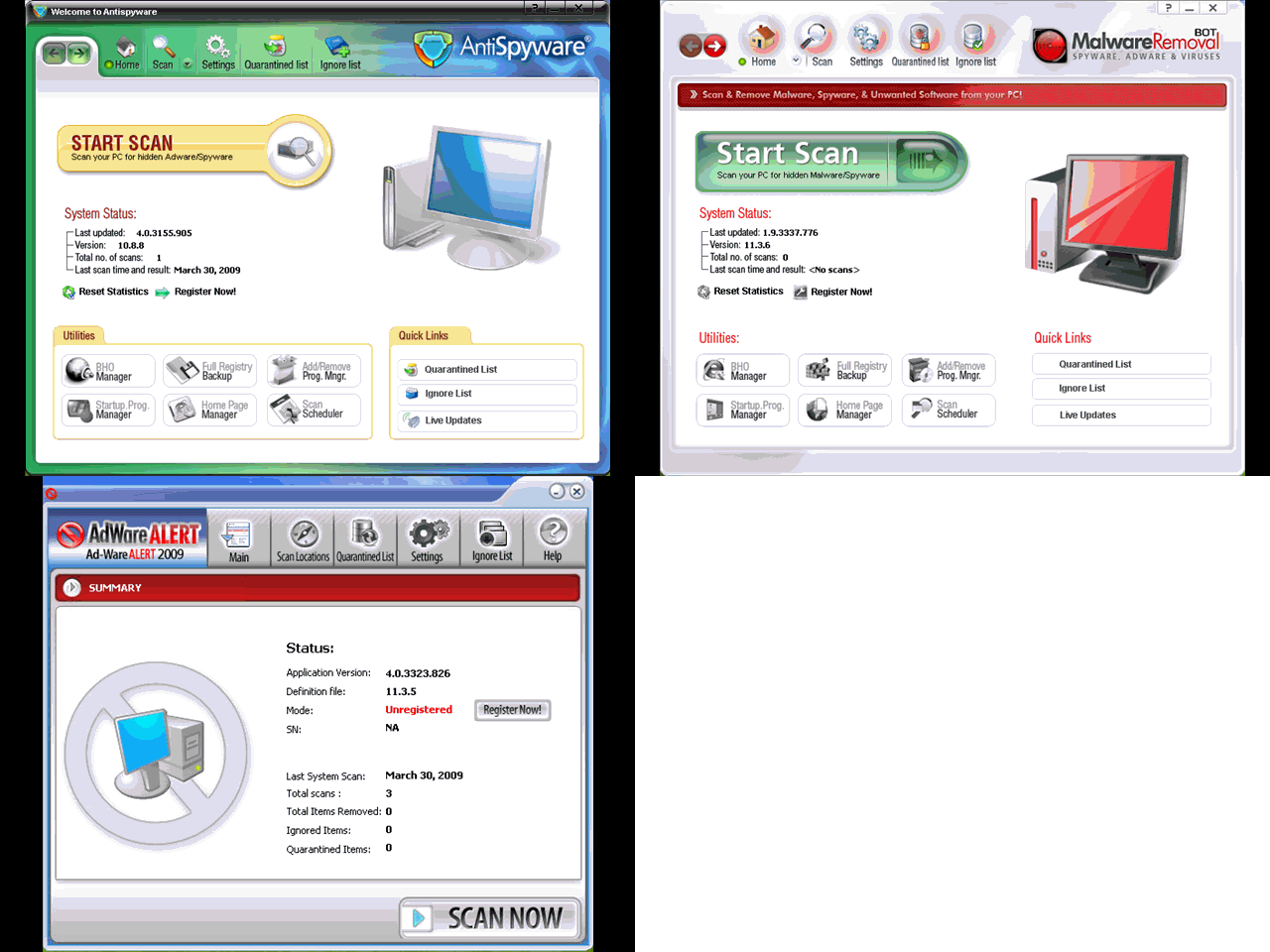
Like AdwareAlert and AntiSpy2009, it is clear that it's an affiliate program going on.


Get your facts from known sites and download your removal tools from respected companies. Such as ours which you can find here.

Wednesday, April 1, 2009

Call of Duty: Modern Warfare 2 confirmed

Activision has named practically its entire 2009 line-up at an in-game advertiser meeting, including Infinity Ward's Call of Duty: Modern Warfare 2.

UPDATE: Here's the first teaser trailer.


CALL OF DUTY MODERN WARFARE 2 TEASER TRAILER - RELEASE NOV 10TH 09!

And while you're here be sure to check out our 35 Modern Warfare 2 Random Requests feature.

Speaking at an 'upfront' meeting with in-game ad company Massive Inc. (responsible for the famous Obama Burnout Paradise ad), Activision named its 2009 games including tentatively titled Guitar Hero 5, a new Tony Hawk's and Modern Warfare 2.

The sixth CoD game was already confirmed
to be under Infinity Ward's wing (and not World at War dev Treyarch),
but this news thankfully confirms that number six isn't the rumoured sci-fi spin-off we were dreading.

No details on the game were released, though it was roughly dated for release in autumn 2009.


In the meeting, Activision also confirmed that in the new Tony Hawk's
"you're not going to be playing this game with a controller in your
hands." It's out on PS3, 360, Wii and DS in October. We smell a
peripheral coming...

Bizarrely (ho ho), the publisher also
confirmed PGR dev Bizarre Creations' first Activision racer will be a
James Bond game. In fact it'll be an original racing game that's been
described as "Mario Kart meets Forza". Read more on that here.


We spoke to Activision this afternoon but unfortunately the company
wasn't able to provide any further details about the new games. Don't
hold your breath either, as it seems unlikely there'll be anything more
on them until early next year, but don't let that stop you speculating
in the meantime.

source : http://www.computerandvideogames.com/article.php?id=203174

Saturday, March 28, 2009

Recover Deleted Files With Scalpel

Scalpel is a fast file carver that reads a database of header and footer definitions and extracts matching files from a set of image files or raw device files. Scalpel is filesystem-independent and will carve files from FATx, NTFS, ext2/3, or raw partitions. It is useful for both digital forensics investigation and file recovery. This short article shows how you can use Scalpel to recover deleted files.

I do not issue any guarantee that this will work for you!


1 Preliminary Note

Please note that there's no guarantee that Scalpel will succeed in recovering your files, but at least there's a chance.


2 Installing Scalpel

On Debian and Ubuntu, Scalpel can be installed as follows:

apt-get install scalpel


3 Using Scalpel

Take a look at

man scalpel

to learn how to use Scalpel.

Before we can use Scalpel, we must define some file types that Scalpel should search for in /etc/scalpel/scalpel.conf. By default, all file types are commented out. In this example, I want to search for deleted PDF files, so I uncomment the following lines:

vi /etc/scalpel/scalpel.conf

[...]<br />        pdf     y       5000000 %PDF  %EOF\x0d  REVERSE<br />        pdf     y       5000000 %PDF  %EOF\x0a  REVERSE<br />[...]

Scalpel can be used as follows to try to recover the files:

scalpel /dev/sda1 -o output

-o defines the directory where Scalpel will place the recovered files - in this case the directory is named output and is a subdirectory of the directory where we are running the scalpel command from; the directory must not exist because otherwise scalpel will refuse to start.

(If you don't know what partition to search, take a look at

mount

server1:~# mount
/dev/sda1 on / type ext3 (rw,errors=remount-ro)
tmpfs on /lib/init/rw type tmpfs (rw,nosuid,mode=0755)
proc on /proc type proc (rw,noexec,nosuid,nodev)
sysfs on /sys type sysfs (rw,noexec,nosuid,nodev)
udev on /dev type tmpfs (rw,mode=0755)
tmpfs on /dev/shm type tmpfs (rw,nosuid,nodev)
devpts on /dev/pts type devpts (rw,noexec,nosuid,gid=5,mode=620)
nfsd on /proc/fs/nfsd type nfsd (rw)
server1:~#

)

After Scalpel has finished, you will find a folder called output in the directory from where you called Scalpel:

ls -la

server1:~# ls -la
total 36
drwxr-xr-x  5 root root 4096 2009-03-12 17:53 .
drwxr-xr-x 21 root root 4096 2009-02-16 13:10 ..
drwx------  2 root root 4096 2009-02-16 13:15 .aptitude
-rw-------  1 root root  377 2009-02-16 13:32 .bash_history
-rw-r--r--  1 root root  412 2004-12-15 23:53 .bashrc
drwxr-xr-x  2 root root 4096 2009-02-16 13:17 .debtags
drwxr-xr--  3 root root 4096 2009-03-12 17:53 output
-rw-r--r--  1 root root  140 2007-11-19 18:57 .profile
-rw-------  1 root root 3480 2009-03-12 17:06 .viminfo
server1:~#

ls -l output

server1:~# ls -l output
total 8
-rw-r--r-- 1 root root  386 2009-03-12 19:10 audit.txt
drwxr-xr-x 2 root root 4096 2009-03-12 19:10 pdf-0-0
server1:~#

The audit.txt contains a summary of what Scalpel has done:

cat output/audit.txt

server1:~# cat output/audit.txt

Scalpel version 1.60 audit file
Started at Thu Mar 12 19:01:50 2009
Command line:
scalpel /dev/sda1 -o output

Output directory: /root/output
Configuration file: /etc/scalpel/scalpel.conf

Opening target "/dev/sda1"

The following files were carved:
File              Start                 Chop            Length          Extracted From
00000000.pdf   5712642048               NO           437138             sda1


Completed at Thu Mar 12 19:10:33 2009
server1:~#

And the pdf-0-0/ subdirectory contains the jpg files that Scalpel has recovered:

ls -l output/pdf-0-0/

server1:~# ls -l output/pdf-0-0/
total 432
-rw-r--r-- 1 root root 437138 2009-03-12 19:10 00000000.pdf
server1:~#

Before you run Scalpel the next time from the same directory, you must either delete/rename the current output/ directory (because Scalpel will not start if the output directory is already existing) or use specify another output directory.

source: http://www.howtoforge.com/recover-deleted-files-with-scalpel