Tuesday, April 28, 2009

Mozilla releases Firefox 3.5 beta

Mozilla on Monday released beta 3.5 of Firefox, a revamp of the open-source Web browser designed to include better performance, several new Web programming features, and a private browsing mode.

The earlier betas had been numbered 3.1, but Mozilla switched to the version 3.5 name after concluding the changes were more significant than it envisioned earlier. Mozilla has said earlier the fourth beta will the last, with more polished release candidates expected before the final version of Firefox 3.5 is released.

The software emerges amid what's become a fiercely competitive browser market. Microsoft has released a significant new version, Internet Explorer 8, while Google has entered the market with Chrome and Apple is trying to secure a Windows foothold for its Safari browser. Firefox holds second place in market share to IE.

Among the changes compared with the current Firefox 3.0.x versions are the faster TraceMonkey engine for running Web sites' JavaScript programs; built-in JSON (JavaScript Object Notation) technology for exchanging data between servers and browsers; support for tags to describe audio and video content the way images have been available for years; the private browsing mode for leaving no traces on your computer while surfing; support for technology to let permitted applications know the user's location; and support for the Web workers standard for letting a browser perform processing in the background without holding back a Web application's user interface.

There are a number of known problems with Gmail and with AVG SafeSearch v8.0 on Windows, and as usual, many of those extensions that are so popular on Firefox could break. For details, check the release notes.


Thursday, April 9, 2009

Conficker Hype Used by Rogue Gangs

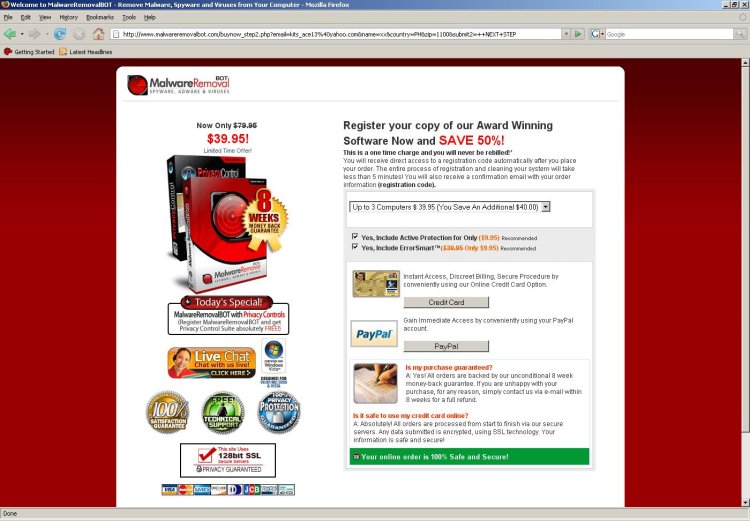
As you're all aware Conficker has been in the news a lot lately, especially with regards to if anything will happen on April 1st or not. We found out that rogue security software folks have picked up on this. For example, let's have a look at remove-conficker.org, a domain which was registered today:


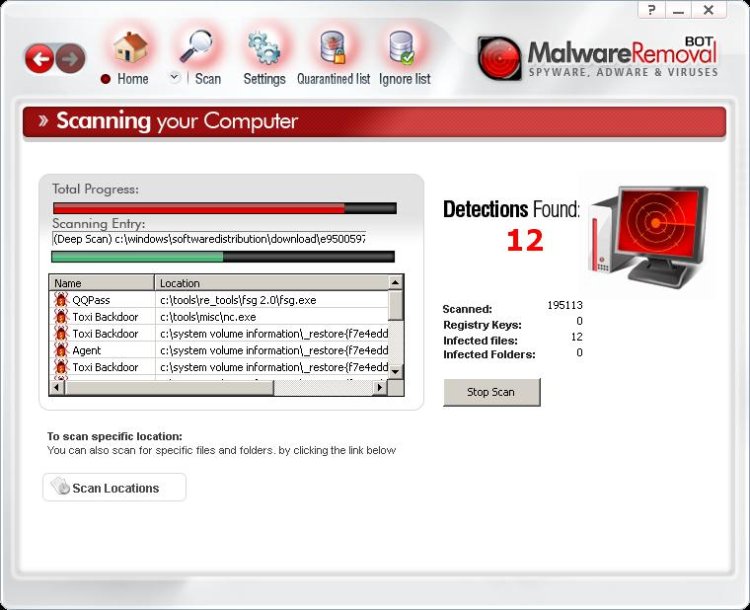
They advertise a tool called MalwareRemovalBot. It's fake. Interestingly, it doesn't always find non-existing malware infections on your PC — only sometimes. But one thing is for sure, it does not remove Conficker.C. We tried it and it didn't do a thing to remove it.

When it did find something that it claimed to be malware it looked like this:


And then it asked us to register and pay $39.95 for the removal functionality.


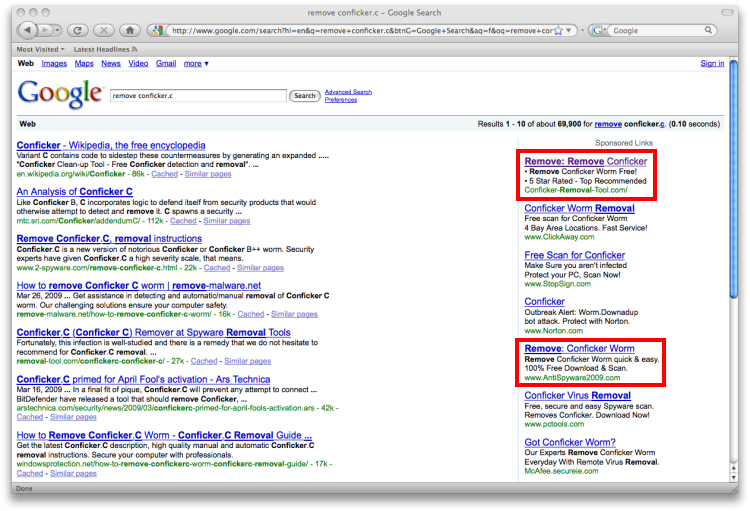
When following up on this we did a Google search for "remove conficker.c" and saw several purchased ads that lead to the same type of "security" software as well.


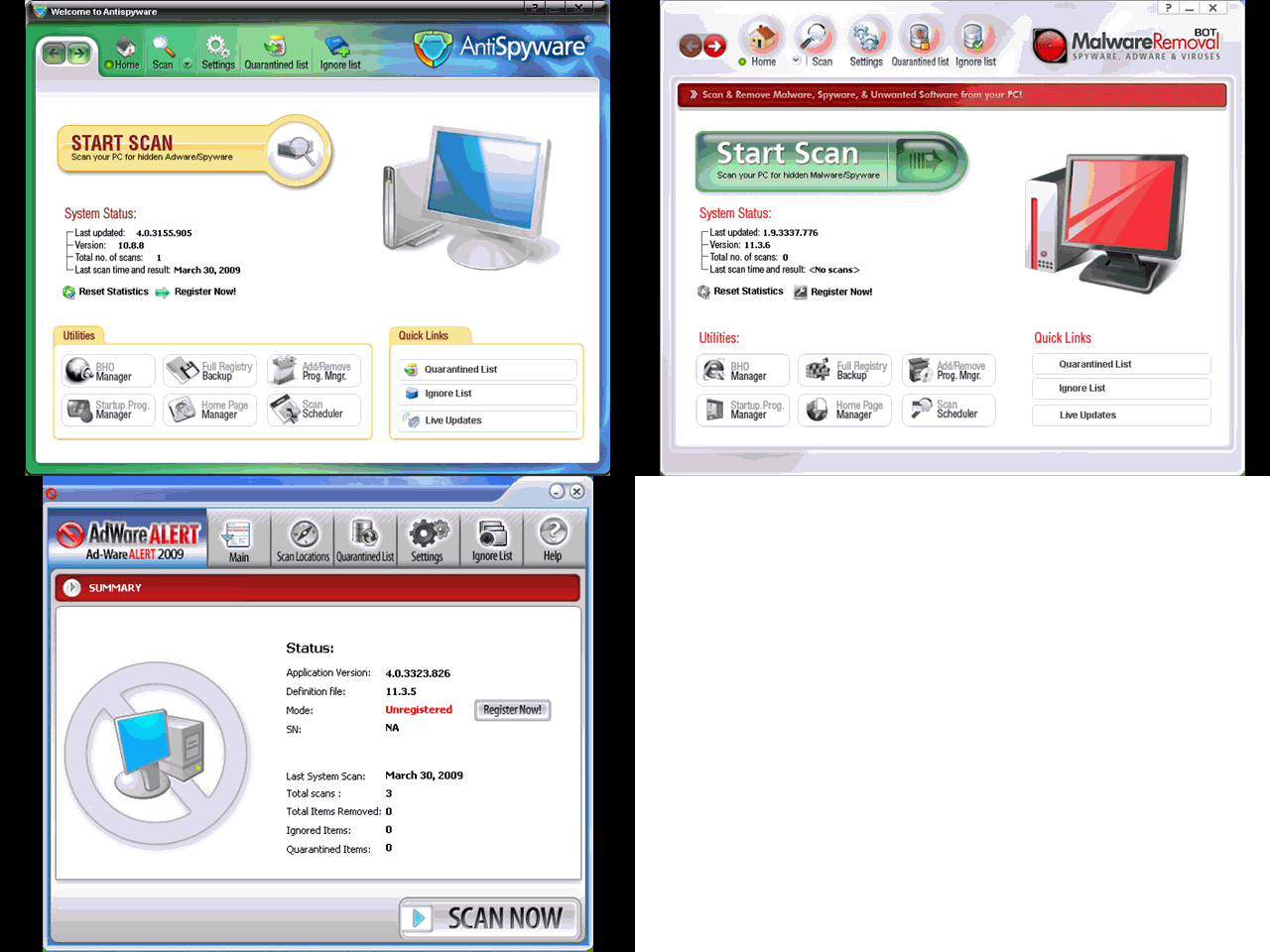
Like AdwareAlert and AntiSpy2009, it is clear that it's an affiliate program going on.


Get your facts from known sites and download your removal tools from respected companies. Such as ours which you can find here.

Wednesday, April 1, 2009

Call of Duty: Modern Warfare 2 confirmed

Activision has named practically its entire 2009 line-up at an in-game advertiser meeting, including Infinity Ward's Call of Duty: Modern Warfare 2.

UPDATE: Here's the first teaser trailer.


CALL OF DUTY MODERN WARFARE 2 TEASER TRAILER - RELEASE NOV 10TH 09!

And while you're here be sure to check out our 35 Modern Warfare 2 Random Requests feature.

Speaking at an 'upfront' meeting with in-game ad company Massive Inc. (responsible for the famous Obama Burnout Paradise ad), Activision named its 2009 games including tentatively titled Guitar Hero 5, a new Tony Hawk's and Modern Warfare 2.

The sixth CoD game was already confirmed
to be under Infinity Ward's wing (and not World at War dev Treyarch),
but this news thankfully confirms that number six isn't the rumoured sci-fi spin-off we were dreading.

No details on the game were released, though it was roughly dated for release in autumn 2009.


In the meeting, Activision also confirmed that in the new Tony Hawk's
"you're not going to be playing this game with a controller in your
hands." It's out on PS3, 360, Wii and DS in October. We smell a
peripheral coming...

Bizarrely (ho ho), the publisher also
confirmed PGR dev Bizarre Creations' first Activision racer will be a
James Bond game. In fact it'll be an original racing game that's been
described as "Mario Kart meets Forza". Read more on that here.


We spoke to Activision this afternoon but unfortunately the company
wasn't able to provide any further details about the new games. Don't
hold your breath either, as it seems unlikely there'll be anything more
on them until early next year, but don't let that stop you speculating
in the meantime.

source : http://www.computerandvideogames.com/article.php?id=203174

Saturday, March 28, 2009

Recover Deleted Files With Scalpel

Scalpel is a fast file carver that reads a database of header and footer definitions and extracts matching files from a set of image files or raw device files. Scalpel is filesystem-independent and will carve files from FATx, NTFS, ext2/3, or raw partitions. It is useful for both digital forensics investigation and file recovery. This short article shows how you can use Scalpel to recover deleted files.

I do not issue any guarantee that this will work for you!


1 Preliminary Note

Please note that there's no guarantee that Scalpel will succeed in recovering your files, but at least there's a chance.


2 Installing Scalpel

On Debian and Ubuntu, Scalpel can be installed as follows:

apt-get install scalpel


3 Using Scalpel

Take a look at

man scalpel

to learn how to use Scalpel.

Before we can use Scalpel, we must define some file types that Scalpel should search for in /etc/scalpel/scalpel.conf. By default, all file types are commented out. In this example, I want to search for deleted PDF files, so I uncomment the following lines:

vi /etc/scalpel/scalpel.conf

[...]<br />        pdf     y       5000000 %PDF  %EOF\x0d  REVERSE<br />        pdf     y       5000000 %PDF  %EOF\x0a  REVERSE<br />[...]

Scalpel can be used as follows to try to recover the files:

scalpel /dev/sda1 -o output

-o defines the directory where Scalpel will place the recovered files - in this case the directory is named output and is a subdirectory of the directory where we are running the scalpel command from; the directory must not exist because otherwise scalpel will refuse to start.

(If you don't know what partition to search, take a look at

mount

server1:~# mount
/dev/sda1 on / type ext3 (rw,errors=remount-ro)
tmpfs on /lib/init/rw type tmpfs (rw,nosuid,mode=0755)
proc on /proc type proc (rw,noexec,nosuid,nodev)
sysfs on /sys type sysfs (rw,noexec,nosuid,nodev)
udev on /dev type tmpfs (rw,mode=0755)
tmpfs on /dev/shm type tmpfs (rw,nosuid,nodev)
devpts on /dev/pts type devpts (rw,noexec,nosuid,gid=5,mode=620)
nfsd on /proc/fs/nfsd type nfsd (rw)
server1:~#

)

After Scalpel has finished, you will find a folder called output in the directory from where you called Scalpel:

ls -la

server1:~# ls -la
total 36
drwxr-xr-x  5 root root 4096 2009-03-12 17:53 .
drwxr-xr-x 21 root root 4096 2009-02-16 13:10 ..
drwx------  2 root root 4096 2009-02-16 13:15 .aptitude
-rw-------  1 root root  377 2009-02-16 13:32 .bash_history
-rw-r--r--  1 root root  412 2004-12-15 23:53 .bashrc
drwxr-xr-x  2 root root 4096 2009-02-16 13:17 .debtags
drwxr-xr--  3 root root 4096 2009-03-12 17:53 output
-rw-r--r--  1 root root  140 2007-11-19 18:57 .profile
-rw-------  1 root root 3480 2009-03-12 17:06 .viminfo
server1:~#

ls -l output

server1:~# ls -l output
total 8
-rw-r--r-- 1 root root  386 2009-03-12 19:10 audit.txt
drwxr-xr-x 2 root root 4096 2009-03-12 19:10 pdf-0-0
server1:~#

The audit.txt contains a summary of what Scalpel has done:

cat output/audit.txt

server1:~# cat output/audit.txt

Scalpel version 1.60 audit file
Started at Thu Mar 12 19:01:50 2009
Command line:
scalpel /dev/sda1 -o output

Output directory: /root/output
Configuration file: /etc/scalpel/scalpel.conf

Opening target "/dev/sda1"

The following files were carved:
File              Start                 Chop            Length          Extracted From
00000000.pdf   5712642048               NO           437138             sda1


Completed at Thu Mar 12 19:10:33 2009
server1:~#

And the pdf-0-0/ subdirectory contains the jpg files that Scalpel has recovered:

ls -l output/pdf-0-0/

server1:~# ls -l output/pdf-0-0/
total 432
-rw-r--r-- 1 root root 437138 2009-03-12 19:10 00000000.pdf
server1:~#

Before you run Scalpel the next time from the same directory, you must either delete/rename the current output/ directory (because Scalpel will not start if the output directory is already existing) or use specify another output directory.

source: http://www.howtoforge.com/recover-deleted-files-with-scalpel


Thursday, February 12, 2009

Whee! New numbers on social network usage

Ranked by Monthly Visits, Jan '09

(Credit: Compete.com)

The blogosphere simply loves to slurp up social-networking traffic stats, and on Monday we got a nice tasty serving of them with some new numbers from Compete.com
for the month of January. The results? Facebook is in the lead, with
about 68 million unique visitors, well ahead of MySpace's 58 million.
(The two are pegged at 1.1 billion and 810 million page views,
respectively.)


This may be the first survey we've seen that puts Facebook ahead of the News Corp.-owned MySpace
in U.S. traffic. It also puts Twitter as the third-biggest social-media
site in the country by total page views, with only about six million
unique visitors but a whopping 54 million views.


Compete's numbers are interesting, because they often are pretty
different from other analytics firms'. Here are some clarifications,
explained to CNET News in an e-mail sent by Compete's Andy Kazeniac:
These are numbers stemming entirely from Web browser data in the U.S.
That means that you won't be pulling in any international numbers,
where most of Facebook's users are now, or data from widgets or
third-party applications, which are how many avid Twitter users access
the service. That means that it's likely that Twitter's reach is bigger
than the numbers indicate.


What's also intriguing is that there are a few social-media sites,
like Flixster and LiveJournal, with relatively low unique visitor
counts but proportionally very high page view counts, indicating that
they probably have smallish bases of very loyal users.


Also pulling in notable numbers are LinkedIn, with about 11 million
unique users, Classmates.com, with about 17 million, and Reunion.com,
with slightly under 14 million. On the other end? AOL's Bebo, an $850 million purchase,
which Compete.com clocks in as having just shy of three million unique
visitors. True, its biggest user bases are in the U.K. and Ireland, but
that's not good considering the price tag.


Still, statistics are like tequila shots. Always take 'em with a few
grains of salt and a slice of lime, and be warned that they may give
you headaches.

source: news.com